People picture AI as something you switch on. Running it is closer to running a fleet. It works because somebody checks it every day.
← Dispatch 
What I check every morning: running AI in production
AI does not run itself. The three things I check before anything else, and why 99.9% of our automated runs succeed.
Ben Sporn Founder of Eagle Eye
Adapted from Ben's interviews on Auto Finance News and CBT Live.
In this article 5 sections
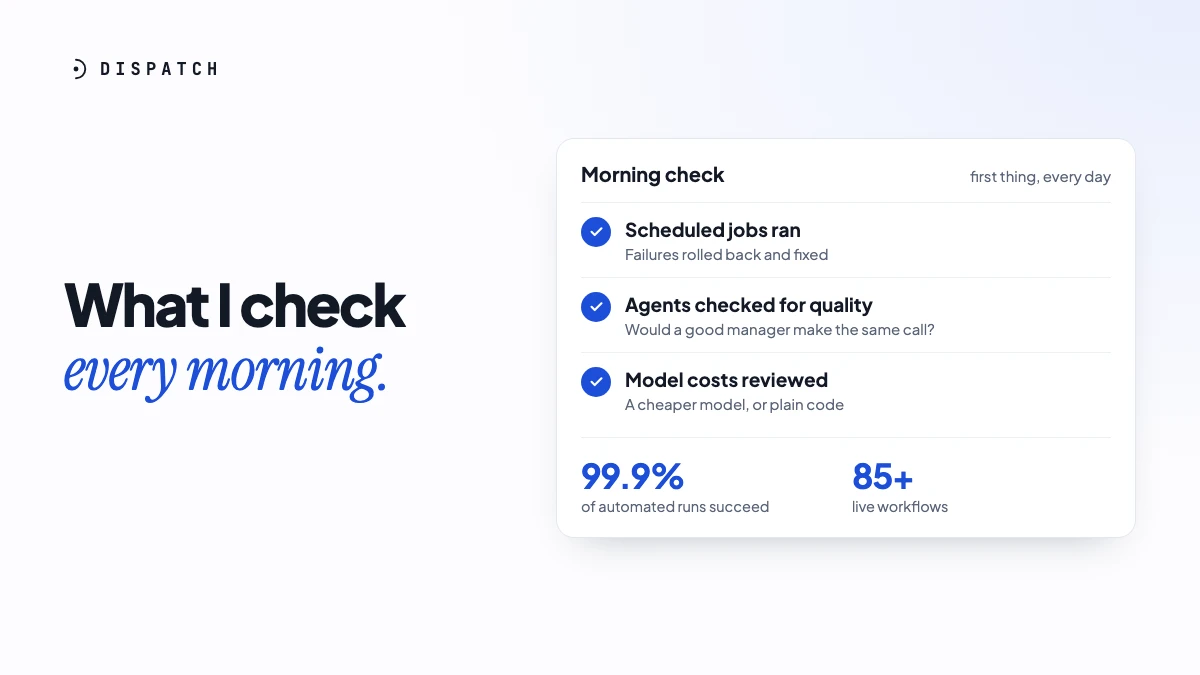
I am CMO of VIP Automotive Group, and I build and run the AI behind our ten rooftops. Before I look at marketing or the parts business, I look at the machines. More than 85 workflows are live, they make more than 35,000 automated runs a month, and 99.9% of those runs succeed. That last number is the reason for the routine.
First thing in the morning, checking, making sure all my cron jobs went out successfully, if there's any failures, reverting, and fixing them.
First: did everything run?
Most of our automation lives in workflows that run on a schedule, what engineers call cron jobs. Build tomorrow's service packets. Draft the replies waiting in the parts inbox. Pull the reports managers read before their first meeting. Each one is supposed to fire at a set time and produce a set output.
So the first check is simple: did every scheduled job go out, and did any fail? A failure gets rolled back and fixed before anyone downstream notices the gap. When a workflow breaks, the cause is usually mundane: a vendor renames a field, a login expires, a file arrives in a format nobody expected. Mundane is good. It means the design is sound and the plumbing needs a wrench.
Second: are the agents still making good calls?
Agents are different from workflows. They use a model to make a judgment: checking our prices against competitors, reviewing internal operations for things that look off, listening to calls and passing what matters to managers. A workflow either ran or it did not. An agent can run perfectly and still drift.
So the second check is quality, not uptime. That means QA on what the agents produced, and asking whether a good manager would have made the same call. When the answer is no, the fix is usually context rather than a smarter model: the agent was missing something a person would have known.
Third: what is this costing, and does it still need a model?
Every workflow gets more predictable as it matures. Once a step has run enough times, you can often see that it follows a pattern plain code can handle. So part of every day is model review: which steps could move to a cheaper model, and which could come off AI entirely.
That is why our token bill has gone down while the work running through these systems keeps growing. The method is in Don't put a student driver in a Ferrari.
Then: the software
The last bucket is the fun one: building full software to replace tools we used to rent, and growing the ones we already built. Each tool has a champion inside the company, a person who uses it every day and tells me what to change. That relationship is its own discipline, and I wrote it up in Give every tool a champion.
What this means if you are buying AI
If a vendor or a consultant tells you their AI runs itself, ask who checks it tomorrow morning. Somebody has to. These systems cannot just be turned on and left. The ones that survive have an owner, a routine, and a way to switch them off, which is most of the AI deployment checklist.
If you are building it yourself, put the check on the calendar before the first workflow goes live. It does not need to take long at the start. It is what separates a system your team trusts from one they quietly stop using.
Start with one function
A 30-minute call. We map where your operation leaks time and scope what to automate first.
Book a Call