There is a habit I see everywhere right now: token maxing. Somebody discovers the newest frontier model and runs everything through it. Every summary, every classification, every reformatted spreadsheet goes to the most expensive intelligence on the market.
← Dispatch 
Don't put a student driver in a Ferrari
Frontier models for frontier tasks. How we pick a model, decide where the human sits, and keep the token bill falling while the work grows.
Ben Sporn Founder of Eagle Eye
Adapted from Ben's interviews on CBT Live and Daily Dealer Live.

In this article 5 sections
That is putting a student driver in a Ferrari. It is expensive, and the car is wasted on the drive.
It's kind of like putting a student driver in a Ferrari, where you have to make sure you match the right model with the right task at hand.
We are model agnostic on purpose. Frontier intelligence for frontier tasks. Everything else goes to whatever is cheapest and good enough, and that bar is lower than most people think.
Start with the task, not the model
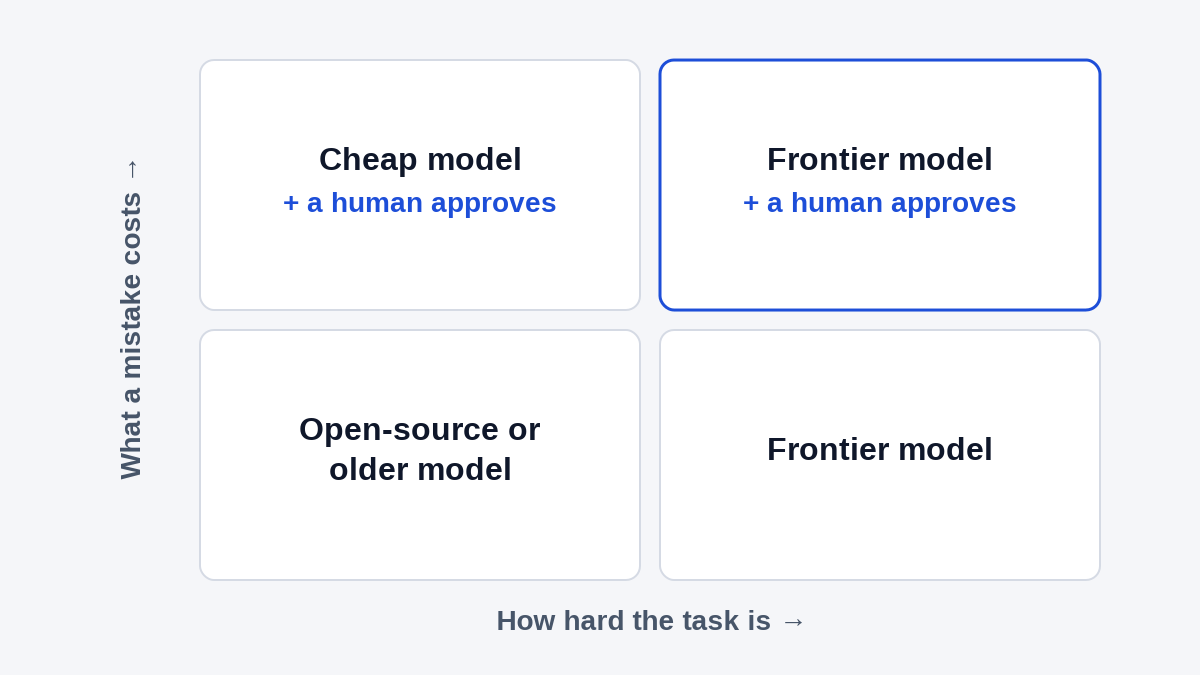
Before we pick a model, we break the task down on two questions.
- How hard is it? Reading a messy customer email with three questions buried in it takes real reasoning. Pulling a VIN out of a form does not.
- What happens if it is wrong? An internal report with a mislabeled column costs a manager thirty seconds. A wrong answer sent to a customer costs you the customer, and maybe a compliance problem.
Low difficulty and low risk goes to an open-source model, which is effectively free at the margin, or to a frontier model a few generations back. High difficulty earns the expensive model. High risk earns a human, whatever model you use.
Then decide where the human sits
"Human in the loop" gets said a lot and specified rarely. Be exact about it. A person can sit in one of three places:
- At the front of the loop. They trigger the automation. A manager clicks a button and the work starts.
- In the loop. The workflow runs, comes back to them for a decision, and only goes out after they approve it. That is how our customer-facing drafts work.
- On the loop. The automation runs on its own and the human watches the output, stepping in when something looks off. This is for internal, low-risk work.
You can do this on a whiteboard. Draw the task as boxes. Circle the exact box where a person has to make a call. That circle is your design.
Anything customer-facing is deterministic
We do not leave customer messaging up to chance. Information comes in from everywhere and lands in one place, but what goes out to a customer is tightly controlled and reviewed by a person.
Our service history sheet is a good example of where AI belongs. Customers lose the paper records in the glove box and forget what has been done. So we build them one page with their full history every time they come in. That is low risk and high certainty: it is their own record, organized. The actual recommendation, what the car needs today, stays with the advisor.
The cheapest AI call is the one you delete
Once a workflow has run long enough, you can see which steps actually need a model. Often a step that started as an AI call turns out to follow a pattern a few lines of ordinary code can handle. So we convert it. No tokens, no variance, nothing to hallucinate.
Do this consistently and something counterintuitive happens. Our token bill has gone down since we started, not up, while the amount of work running through these systems keeps growing. The models got better, the open-source models got better with them, and we stopped paying frontier prices for chores.
The checklist
- Dissect the task. How hard is it, and what does a mistake cost?
- Match the model to the task, not to the hype cycle.
- Mark the exact point where a human decides.
- Keep anything a customer sees reviewed by a person.
- Review every few months and turn AI steps into plain code where you can.
Put the student driver in a sedan. Save the Ferrari for the track.
Start with one function
A 30-minute call. We map where your operation leaks time and scope what to automate first.
Book a Call