Forward deployed AI is AI that is built, installed, and run inside your business by people who sit with your operation, instead of software you buy and configure yourself. The workflows run in your accounts, on your data, approved by your people, and you own all of it when the work is done.
← Dispatch 
What is forward deployed AI?
AI built, installed, and run inside your business by people who sit with your operation. Where the term comes from, and how to tell if it is real.
Ben Sporn Founder of Eagle Eye
In this article 8 sections
It is the opposite of buying a seat. A seat gives one person a faster way to do one task. A deployment removes the task.
Where the term comes from
The phrase comes from the forward deployed engineer: a software engineer who works on site with the customer, embedded with the people doing the job, rather than back at headquarters writing features for a roadmap. Data and defense software firms made the role famous, and it is now one of the fastest-growing jobs in AI.
The reason is simple. Models are good enough now. What most businesses lack is not intelligence, it is the person who can connect a model to the systems they already run, understand how the work actually moves on the floor, and decide what is safe to automate.
Three jobs, one person
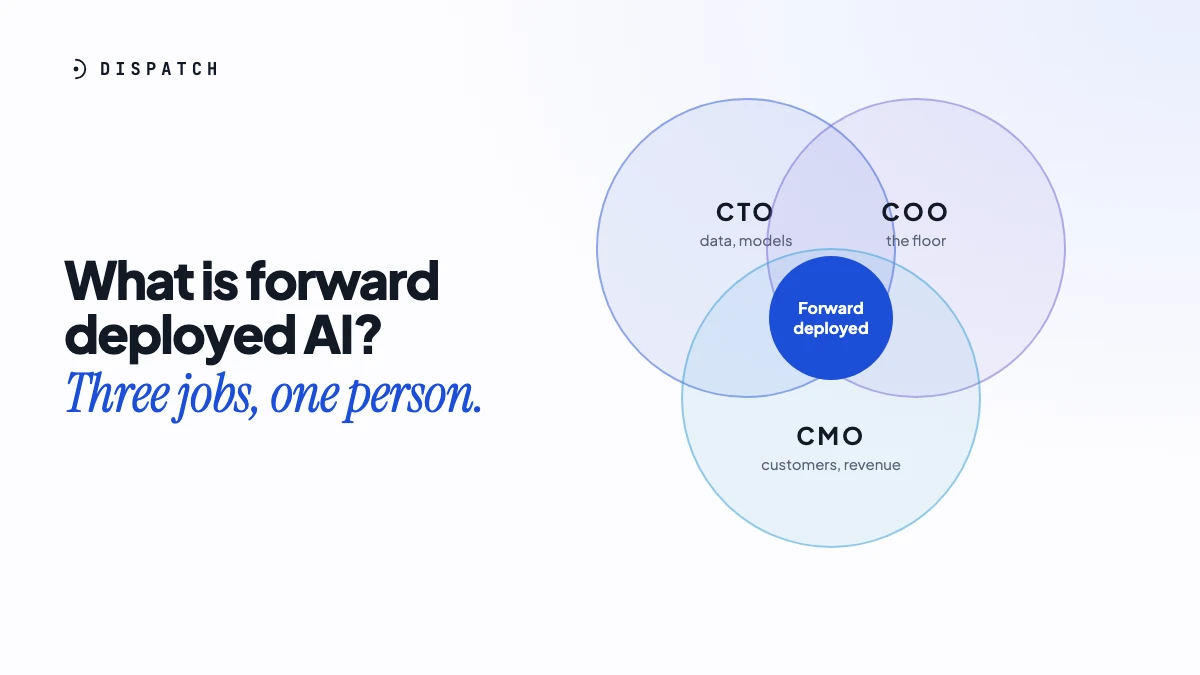
For an operator, the forward deployed engineer is the overlap of three roles that usually live in different people, if they exist at all:
| Role | What it covers |
|---|---|
| CTO | Connectors, data, model and token strategy |
| COO | How the work runs on the floor |
| CMO | Customer response and revenue |
Most groups have all three functions and none of the overlap. The CTO knows the systems but not the service lane. The COO knows the lane but not the APIs. Marketing knows the customer but cannot ship a workflow. AI projects die in the gaps between them. A forward deployed team stands in the middle of all three.
Deployed, not consumed
AI is meant to be deployed, not consumed. Renting an AI product seat by seat means you own nothing at the end of the term, and the work still runs through the same people at the same pace.
Deployed workflows and agents do the work on a clock, whether anyone opens an app or not. They read the inbox, draft the reply, build the report, and flag the exception, then hand it to a named person to approve. Right-sized models on the right tasks also cost far less than running everything through frontier chat seats. For more on that trade-off, read AI consumers prompt from the mean. Producers deploy.
How it compares
| Forward deployed AI | AI software seat | AI consultant | In-house hire | |
|---|---|---|---|---|
| Who builds it | The deployment team, in your accounts | The vendor, for every customer at once | The consultant, often as a prototype | Your hire, once they ramp up |
| Who runs it after launch | The deployment team, with your approvers | You | You, after the handover | Your hire |
| What you own | The workflows, the data, and the software | Nothing when you stop paying | Usually a document | Whatever they built, if they stay |
| How it is paid for | Accountable to results every month | Per seat, for as long as you rent it | Hours or a fixed project | Salary, plus the tools they buy |
| First result | Live in about two weeks | Whenever someone sets it up | After the report | After hiring and ramp |
None of these is wrong for every business. A seat is fine when one person needs to write faster. A consultant is fine when you need a strategy. Forward deployed AI fits when the work is repeated, it runs through systems you already own, and you want it running next month, not described in a deck.
What an engagement looks like
- Friction audit. Map where time and signal are lost, and rank the work by how often it happens and how easy a mistake is to undo. The method is in the friction audit framework.
- Scope one function. Agree the metric and the rollback path before anything is built.
- Run in shadow. Connect the systems and run the agent beside the current workflow, so you see real output before anything ships.
- Go live. Two weeks is the target. Then the next function, once the first one pays.
What it looked like in a working dealer group
Eagle Eye's founder, Ben Sporn, is CMO of VIP Automotive Group, a ten-rooftop group on Long Island, and built this work there himself. In July 2025 it started with one function: AI drafting e-commerce customer service replies, with a person reading and sending every one. Output roughly tripled. Dozens of workflows for time, cost, and revenue followed.
Today the agent work takes more than 3,000 hours a month off the group's people and saves about $1M a year. More than 85 workflows are live, the oldest has been running for over a year, and 99.9% of automated runs succeed. Nobody lost a job, and every department where it is deployed is hiring. The full account is in the VIP Automotive Group case study.
The conjunction of all those mindsets is really where you have the most success with AI.
How to tell if it is real
Plenty of firms will say "forward deployed" now that the phrase is popular. Five questions separate the real thing:
- Where does it live? It should be built in your accounts, on your credentials, not on a platform you rent.
- Who approves the output? There should be a named person on your side for anything negative, sensitive, or about money.
- What is the metric? It should be agreed before building starts, not discovered afterward.
- How do you switch it off? Every agent should ship with a documented rollback.
- What is running today? Ask to see something in production, with real people accountable for it.
Where to start
Pick the work that happens all day and is easy to undo if a draft is wrong. Review replies, voicemail routing, and listing descriptions are the usual first installs. Then let the first one pay for the second.
Start with one function
A 30-minute call. We map where your operation leaks time and scope what to automate first.
Book a Call