Before you deploy any AI agent, you have to see where your operation actually leaks. Not where you think it leaks. Where it actually does. The two are almost never the same.
← Dispatch 
The friction audit: a framework for finding where your business leaks money
Before you automate anything, you have to see everything. Start from friction, not cost: how we find where the hours go and what to fix first.
Ben Sporn Founder of Eagle Eye
Draws on Ben's interviews on Auto Finance News and CBT Live.
In this article 6 sections
The friction audit is how every engagement starts, before a single automation is built. It surfaces a short list of high-impact targets the team had long since accepted as "just how it works."
Start from friction, not cost
Most people approach AI by looking at their biggest cost and asking how to cut it. We start somewhere else: we map the process and find the point where it has the most friction. Time lost by your people is a cost too, and it is usually the larger one. Picture a manager who spends the first hours of every morning listening to yesterday's calls, finding the missed ones, filling out maintenance sheets, and calling people back. Take that off their plate and you have created real leverage for one of your most expensive people.
Log a week before you hold a meeting
Ask a manager where the time goes and you get an honest, confident, wrong answer. So before anyone opens a whiteboard, have three people log a week in fifteen-minute blocks: what they did, which system it was in, and whether it needed their judgment. I wrote about this in The cost of not implementing AI: your guess about where time goes will be wrong.
Three layers to look at
- Time sinks. Where are your best people spending time on work that does not need their judgment? List every repeating task that takes more than 15 minutes a week and sort by total hours. Copying data between systems, rebuilding the same report every Monday, and answering the same five questions by email usually lead the list.
- Exception handling. What breaks, and what does the team do when it does? Returns, billing anomalies, inventory discrepancies, a part on back order. Every exception that needs a person to triage it is a candidate, because the triage is usually lookup and rules.
- Signal capture. What is the business generating that nobody acts on? Reviews, competitor price moves, campaign anomalies, voicemails. Most operations collect signals and throw them away.
Rank what you find
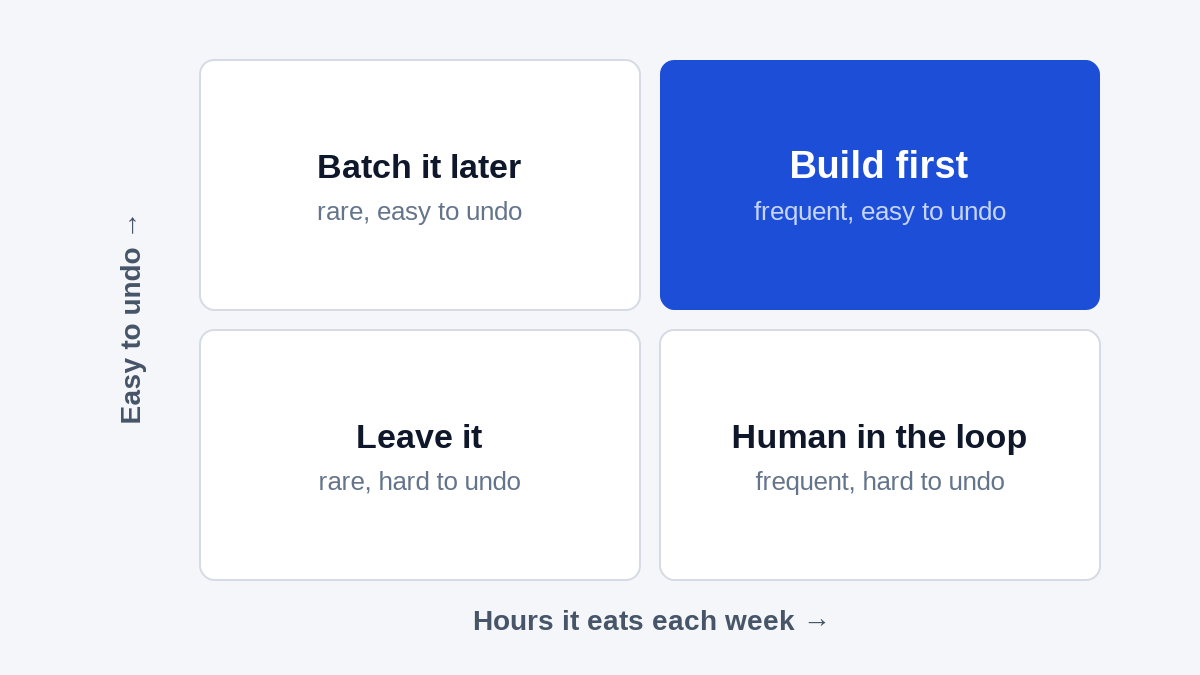
Put every friction point on two axes: time cost (hours a week times the fully loaded labor rate) and reversibility (how easy it is to undo if the automation gets it wrong). Start in the top right of the grid above: the work that eats the most hours and is easiest to undo. A wrong draft that a person catches before it sends costs nothing. A wrong payment does.
Two more questions break ties:
- Can a system reach the data? Work that lives in a system with an API moves first. Work that lives in someone's head moves last.
- Who will own the output? If nobody is named to review it, it will not survive the first month. More on that in the AI deployment checklist.
Audit one job, not only a department
Some of the best targets are a single seat. At VIP Automotive Group, where I am CMO, one person handles insurance claims for all ten rooftops. Their day ran across shared drives, email, spreadsheets, and the occasional fax. The audit of that one job produced ClaimsPointe, a claims tool built around exactly how they work. They are more effective, and they keep asking for more.

Another seat: a service manager building tomorrow's advisor list by hand the night before, roughly an hour a day of pure lookup and rules. That one became a PDF that lands in the managers' inbox before anybody gets in.
What you walk away with
A ranked list, with the top three targets scoped well enough to build: the metric, the person who approves the output, and how to switch it off. Build the first one, run it beside the old way, and let it pay for the second. You will not automate everything, and you should not try. The order matters more than the count.
To size the hours before you start, the ROI calculator does the arithmetic. To run the audit with us, it is the first 30 minutes of a call.
Start with one function
A 30-minute call. We map where your operation leaks time and scope what to automate first.
Book a Call