If you are not replying to reviews, you are losing deals. A buyer reads your replies before they call, fill out a form, or walk in, and silence reads as indifference. A defensive reply to a bad review reads worse.
← Dispatch 
Why review response automation is the easiest ROI in your business
Every unanswered review is a missed conversion. How to size the gap at your own store, and how one build paid off three ways.
Ben Sporn Founder of Eagle Eye
Draws on Ben's interview on Auto Remarketing.
In this article 6 sections
Most operators know this. Most still do not do it consistently. The gap is bandwidth, not intent.
Size the gap at your own store
Skip the industry averages and pull your own numbers. It takes ten minutes:
- Count the reviews you received in the last 90 days, across every platform: Google, DealerRater, Cars.com, Edmunds, Facebook.
- Count how many got a reply at all, and how many got one within a day.
- Time how long a good reply takes the person who usually writes them, then multiply.
The answer usually has the same shape: a reply rate that drops every time the store gets busy, a backlog of three-star reviews nobody wanted to touch, and replies that all say the same thing. The minutes are rarely the problem. The inconsistency is.
Why it is the easiest ROI
- The volume never stops. Reviews arrive every day, so a system that handles them pays back every day.
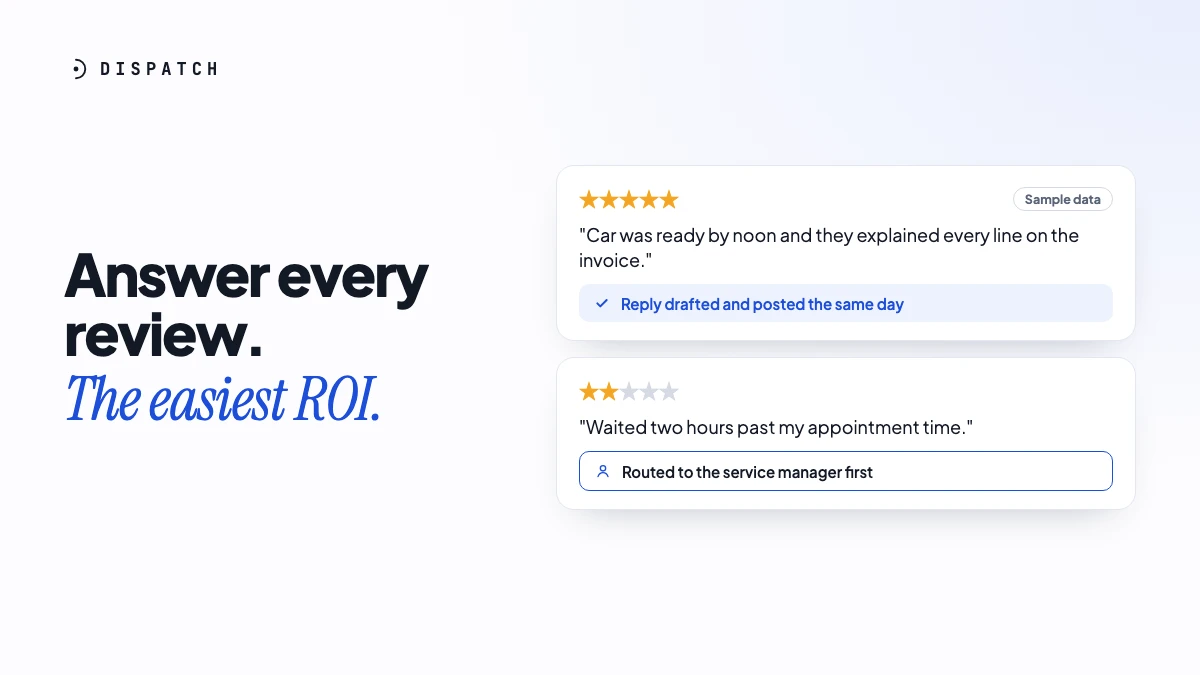
- The risk is easy to control. Positive reviews get a reply that matches what the customer said. Anything negative or nuanced goes to a named person first.
- It compounds in search. Every reply is fresh text on your profile. With the store's services and location worked in naturally, each one helps the profile do its job for the next shopper.
- It is light to install. The review platforms are the system. There is no DMS write-back and no workflow redesign, so it is usually one of the first agents to go live.
One build, three mindsets
When we automated reviews at VIP Automotive Group, where I am CMO, the build was the easy part. What made it pay was looking at it from three seats at once.
- The technical seat: take each inbound review, have AI draft a response, and push it back out to Google.
- The operator seat: once every review is tracked, you can score it. That gave us new metrics for bonusing salespeople and managers on generating more reviews, and better ones.
- The marketing seat: we keep a central list of the search terms we are going after, which we call the company brain. Those terms get worked into the replies.
Any one of those alone is a small win. Together they are where the upside came from. That overlap is what I mean by a forward deployed build.
What the agent does
The Review Response Engine (EE-002) watches each connected platform, drafts a reply matched to the tone and content of each review, and routes anything negative or nuanced to a person for approval. Positive reviews get a consistent, on-brand reply the same day. The Review Tracker (EE-016) keeps the score: volume, rating, and reply rate by store.
What a person still does
The angry review about a service visit is a customer, not a content task. The agent drafts a reply and flags it. The service manager reads the repair order, calls the customer, and decides what the public reply should say. That is the part of the job worth a manager's time, and it is the part that used to get skipped while they were writing thank-you notes to five-star reviews.
Where to start
Connect the platforms and run the drafts in shadow for a week while your team keeps replying the old way. Compare them side by side. If the drafts are as good as what your people write, switch the positive ones on and keep the negative ones with a person. Then use the tracker to decide who gets the bonus.
Start with one function
A 30-minute call. We map where your operation leaks time and scope what to automate first.
Book a Call