When ChatGPT launched, I had a panic attack for two or three days. I could see where the technology was going, and I did not know where that left our business. Then I got to work.
← Dispatch 
Where to start if you want to build AI yourself
You do not need a developer to start. The first tools to learn, the first workflow to build, and the rule that keeps it safe.
Ben Sporn Founder of Eagle Eye
Adapted from Ben's interviews on Auto Finance News, Auto Remarketing and CBT Live.
In this article 5 sections
Today the AI at VIP Automotive Group, where I am CMO, saves about $1M a year and takes more than 3,000 hours a month off human hands. Nobody lost a job. I built most of it myself, without hiring outside developers. This is the path I would recommend to anyone starting now.
We can do it all in-house and we're able to be radically self-reliant without needing to hire external developers, external designers.
Step one: learn node-based automation
Start with a visual automation tool such as Zapier, Make, or n8n. You connect boxes, called nodes, and each box does one thing: watch an inbox, look up a record, call a model, send a message.
The tool matters less than the vocabulary. A few simple workflows teach you how automation thinks: triggers, branching, looping, what happens when a step fails. Once those terms are second nature, every AI system you look at gets easier to understand, whether you build it or buy it.
Step two: pick an inbox that never empties
My first build was customer service for our internet parts business. The inbox was always behind, and it felt bad going home knowing customers were waiting. Unanswered tickets turn into bad reviews and canceled orders.
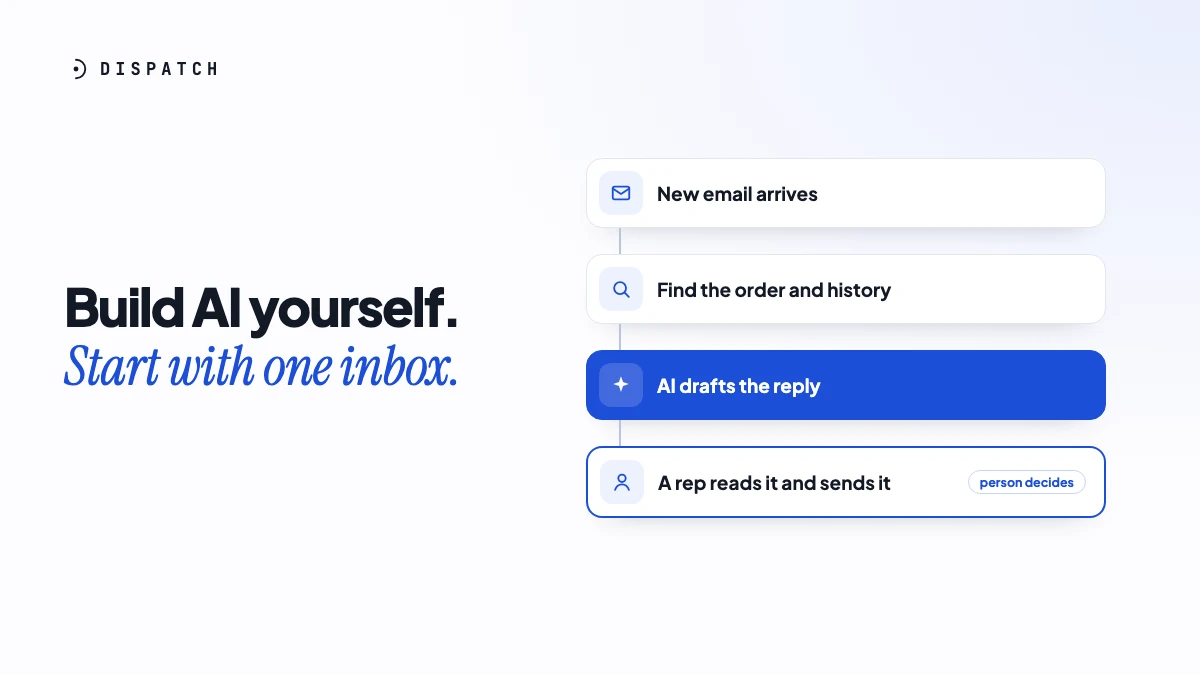
The workflow reads each incoming email, finds the order, checks our order and shipping systems and the customer's past tickets, and drafts a reply. The draft lands in the rep's inbox, and the rep reads it and sends it. That roughly tripled the team's output. Since July it has drafted more than 30,000 replies across 15 parts storefronts, and a person sent every one.
Find your own version: one inbox, one repeated question, one set of systems a person checks before answering. Build the draft, not the decision.
Step three: keep a person on anything sensitive
These systems cannot just be switched on. Anything that goes out to a customer, and anything that touches sensitive data, needs a person who approves it. In a dealership that means finance and credit above all. Be exact about where the person sits: at the front of the loop to trigger the work, in the loop to approve it, or on the loop to watch it. I go through that in Don't put a student driver in a Ferrari.
Step four: workflows, then agents, then software
We deploy AI in three buckets, and most people should meet them in this order:
- Workflows. Scheduled, predictable steps that use AI for one specific output.
- Agents. Systems that use a model to make a judgment, such as reading a messy request and deciding what it is.
- Software. Full tools you build and own, replacing tools you used to rent.
Each bucket builds on the skills of the one before. We now run more than 85 live workflows and have built more than ten custom software products this year. It started with one inbox.
The goal is self-reliance
The biggest payoff is not any single tool. It is no longer having to call someone every time you want something to work differently: no outside developer, no agency, no new contract. When a manager asks for a change on Monday, it can be live on Tuesday.
You will not get there in a month. You get there one workflow at a time. Start with the inbox.
Start with one function
A 30-minute call. We map where your operation leaks time and scope what to automate first.
Book a Call