Fixed operations, or fixed ops, is the side of a car dealership that earns money after the sale: the service department, the parts department, and the body shop. Variable operations sell new and used cars. Fixed ops maintains, repairs and supplies them, and its revenue keeps coming in whether or not the showroom has a good month.
← Dispatch 
What is fixed ops at a car dealership?
Service, parts and the body shop: what fixed operations covers, why it is called fixed, and why it is where AI gives back the most hours.
Ben Sporn Founder of Eagle Eye
In this article 8 sections
- Why is it called fixed ops?
- What departments are in fixed operations?
- What does a fixed operations director do?
- Fixed ops vs variable ops
- Why does fixed ops matter so much to a dealership?
- Where does AI help in fixed ops?
- What does 1 in 10 missed parts mean for a service department?
- Where should a fixed ops director start with AI?
It is also where the hours go. Every repair order, parts quote, warranty claim and callback runs through a person. That makes fixed ops the place in a dealership where AI gives back the most time.
Why is it called fixed ops?
It is called fixed ops because the work is steady. Car sales swing with incentives, interest rates and inventory, so the industry calls that side variable. Service and parts follow the cars already on the road, and those cars need oil changes, brakes, tires and recall work on a schedule nobody in the building controls. That demand is predictable, so the industry calls it fixed.
People read the name a few ways: fixed costs, or simply the side that fixes cars. For an operator the useful meaning is the dependable one. This revenue shows up when sales slow down, and a store that runs it well can ride out a bad quarter in the showroom.
What departments are in fixed operations?
Fixed operations covers three departments at almost every franchised store:
- Service. Advisors write up the visit, technicians do the work, and the repair order (RO) records every line: labor, parts, warranty or customer pay. Maintenance, repairs, recalls and warranty work all run here. We cover this department in detail on AI for the dealership service department.
- Parts. The parts counter supplies the service lane, sells over the counter, sells wholesale to independent shops, and at many groups runs online parts storefronts as well. More on AI for the dealership parts department.
- Body shop or collision center. Accident repair, much of it paid by insurers, with its own estimators, its own schedule and its own paperwork.
Some groups also put detail, quick lube lanes and tire centers under fixed ops. The common thread is work done on a car after someone bought it.
What does a fixed operations director do?
A fixed operations director runs service, parts and collision as one business, usually across several rooftops. The service and parts managers report to them, and they answer to the general manager or dealer principal for the gross profit those departments produce.
The job is numbers and people. A fixed ops director watches technician productivity and hours sold, effective labor rate, parts inventory and obsolete stock, customer satisfaction scores, warranty claims, and how many customers keep coming back after the warranty ends. On a normal day it also means chasing what fell through the cracks: an unreturned call, a part nobody ordered, a line left off an RO.
Most of that chasing is reading. Somebody has to read the closed tickets, the voicemails, the parts emails and the recall lists to find the problem. That reading is exactly the work AI is good at.
Fixed ops vs variable ops
Fixed ops earns from cars already on the road; variable ops earns from cars being sold this month. Side by side:
| Fixed operations | Variable operations | |
|---|---|---|
| Departments | Service, parts, body shop | New cars, used cars, finance and insurance |
| What drives revenue | Cars already on the road | Shoppers in the market this month |
| How steady it is | Steadier, because every car needs upkeep | Swings with incentives, rates and inventory |
| How often the customer visits | Every few months | Every few years |
| Where the paperwork piles up | Repair orders, parts orders, warranty claims | Deal jackets and F&I paperwork |
Why does fixed ops matter so much to a dealership?
Fixed ops matters because it pays the bills that do not move. Dealers track this as service absorption: the share of the store's fixed overhead (rent, salaried staff, utilities) covered by the gross profit from service and parts. A store with strong absorption can survive a slow sales month. A store with weak absorption lives and dies by the showroom.
It is also where loyalty is won. A customer meets the sales team once every few years. The same customer meets the service drive every few months, and how that visit goes shapes where they buy their next car.
Where does AI help in fixed ops?
AI helps most in fixed ops where the work repeats all day and a person can check the result. Service and parts run on documents (repair orders, parts orders, recall lists, voicemails), and documents are what AI reads well.
At VIP Automotive Group, a ten-rooftop dealer group where Eagle Eye's founder, Ben Sporn, is CMO, this work is live today:
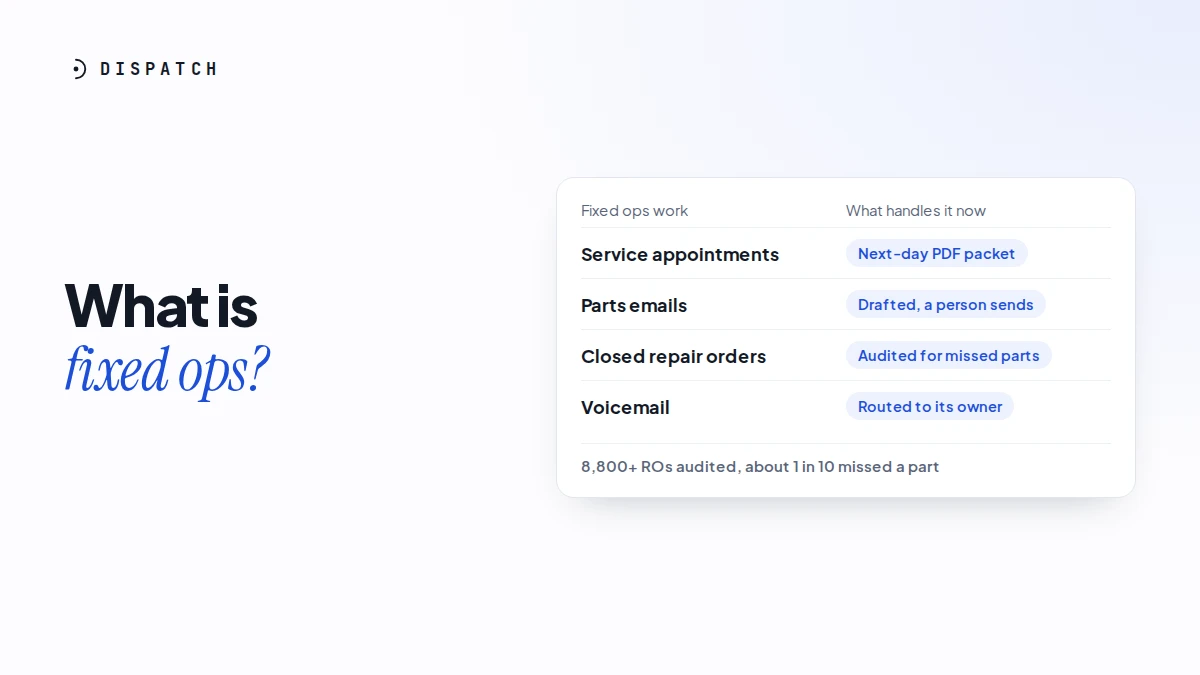
- Repair order audits. AI has audited more than 8,800 closed repair orders for missed companion parts. About 1 in 10 had something missed. Advisors get a companion parts tool, and managers get a missing-parts report for accountability.
- Next-day appointment packets. Every next-day service appointment gets a PDF packet with the menu, the vehicle history and open recalls, so the advisor starts the visit prepared.
- Parts customer service. More than 30,000 customer service replies drafted by AI since July, across 15 parts storefronts. A person reads and sends every one.
- Voicemail. Voicemails transcribed and routed on more than 100 phone extensions, so a message left for the service lane reaches the person who owns it.
Across the group, the agent work takes more than 3,000 hours a month off people's desks. Nobody lost a job.
What does 1 in 10 missed parts mean for a service department?
It means the closed RO is the most underused document in the store. A missed companion part is the gasket that should have gone with the water pump, or the fluid that belongs with the service. Each one is revenue left on that ticket, and sometimes a second trip for the customer.
No manager has time to read every closed RO by hand. An agent can read all of them and put the misses in front of a person who can act on them. That is the pattern for most fixed ops work: the agent does the reading, and people make the calls. The full view across sales, service and parts is on AI for car dealerships.
Where should a fixed ops director start with AI?
Start with the work that repeats every day, is easy to check, and has a clear owner. In fixed ops, three jobs usually fit first:
- The closed RO audit. The misses are money, and checking a flag takes a minute.
- Parts and service email drafts. A person still reads and sends each reply, so a weak draft costs nothing.
- Voicemail routing. A missed call to the service lane is usually a customer waiting on their car.
Pick one. Agree the metric before anything is built, and aim to have it live in two weeks. Then let the first one pay for the second.
Want to see where your service and parts hours go? Book a 30-minute call.
E-commerceAgent / 001
AI Draft CoPilot
Drafts product listings from your catalogue data, at whatever pace it grows.
View agent CommunicationsAgent / 003Voicemail Intelligence
Transcribes every voicemail and routes it to the person who should own it.
View agent OperationsAgent / 004Service Menu Engine
Builds each day's service menu from full vehicle history, before anyone gets in.
View agentStart with one function
A 30-minute call. We map where your operation leaks time and scope what to automate first.
Book a Call