Picture a familiar morning: a GM opens a competitor's website, scrolls their inventory, and updates a shared spreadsheet by hand. Twenty minutes, Monday through Friday. That is more than 80 hours a year of one of the most expensive people in the building copying data anyone can see.
← Dispatch 
Competitor intelligence isn't optional anymore
Your competitors adjust prices every day. Your team checks their websites by hand. That gap is the problem.
Ben Sporn Founder of Eagle Eye
In this article 4 sections
Competitor intelligence used to be hard to get and expensive to produce at scale. It is neither anymore. The only reason it is still done by hand is that nobody set up the alternative.
What to track
Price on one unit is the wrong place to stop. The questions that change a decision are:
- Average discount by model. The pattern across their whole lot: who is discounting, how deep, and on what.
- Inventory count by segment. A competitor sitting on twenty midsize SUVs prices differently from one with four.
- What changed since yesterday. New units, price drops, units pulled. The change is the signal. The snapshot is noise.
At VIP Automotive Group, where I am CMO, the live version tracks competitors' average discounts and inventory counts. It replaced a competitive intelligence tool we used to rent, which is exactly the kind of call I describe in Build the middle.
What the output looks like
Raw data is not the product. A short list of things to act on is:
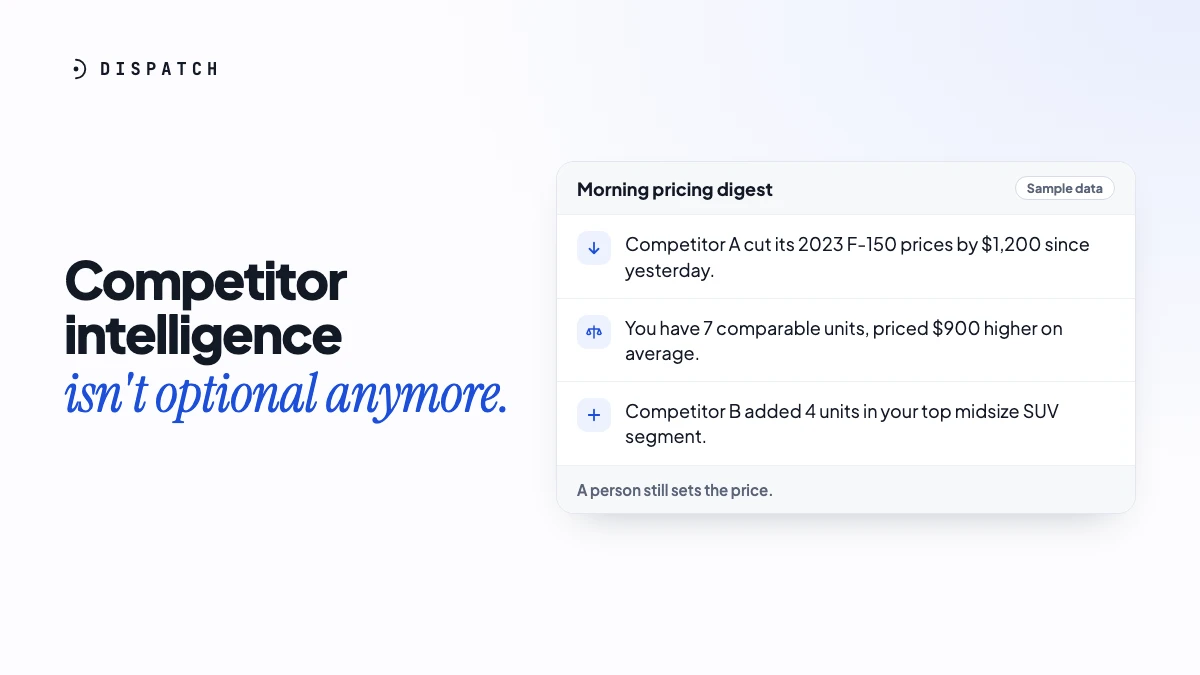
Morning pricing digestSample data
- Competitor A cut the price on its 2023 F-150 inventory by $1,200 since yesterday.
- You have 7 comparable units, priced $900 higher on average.
- Competitor B added 4 units in your top-selling midsize SUV segment.
The Competitor Intelligence agent (EE-006) produces that digest every morning. It is part of Hedron, which watches competitor pricing, marketing performance, and operations for the changes that cost money when nobody notices them.
A person still sets the price
Automated monitoring is not automated pricing. The digest tells a used car manager what moved. The manager decides whether to move with it, hold, or ignore it, because they know what the feed does not: the reconditioning cost on the unit, the trade they took in this morning, the customer coming back on Saturday. Agents draft, people decide.
The compounding effect
No single alert is the point. The point is making every pricing call with today's context instead of last week's. Over a year, that shows up as fewer units sitting at the wrong price, and fewer mornings spent finding out the hard way.
The same pattern works outside the car business. Any operator whose competitors publish prices and stock online, from parts e-commerce to building supply, can watch them the same way.
Start with one function
A 30-minute call. We map where your operation leaks time and scope what to automate first.
Book a Call