A growing share of shopping research is about to be done by software. Instead of opening ten tabs, a customer asks an AI assistant to find the right vehicle, compare prices, check the service hours, and come back with an answer. More of those assistants now act as agents: they visit your site, read it, and report back.
← Dispatch 
AI agents are shopping for your customers. Play offense.
Shoppers are starting to send AI agents to do the research. Blocking them is the wrong instinct. How to hand them clean, accurate answers instead.
Ben Sporn Founder of Eagle Eye
Adapted from Ben's interview on Auto Finance News.
In this article 5 sections
The instinct at a lot of businesses is defense. Block the bots, lock the content, wait and see. Our view at VIP Automotive Group, where I am CMO, is the opposite. Play offense.
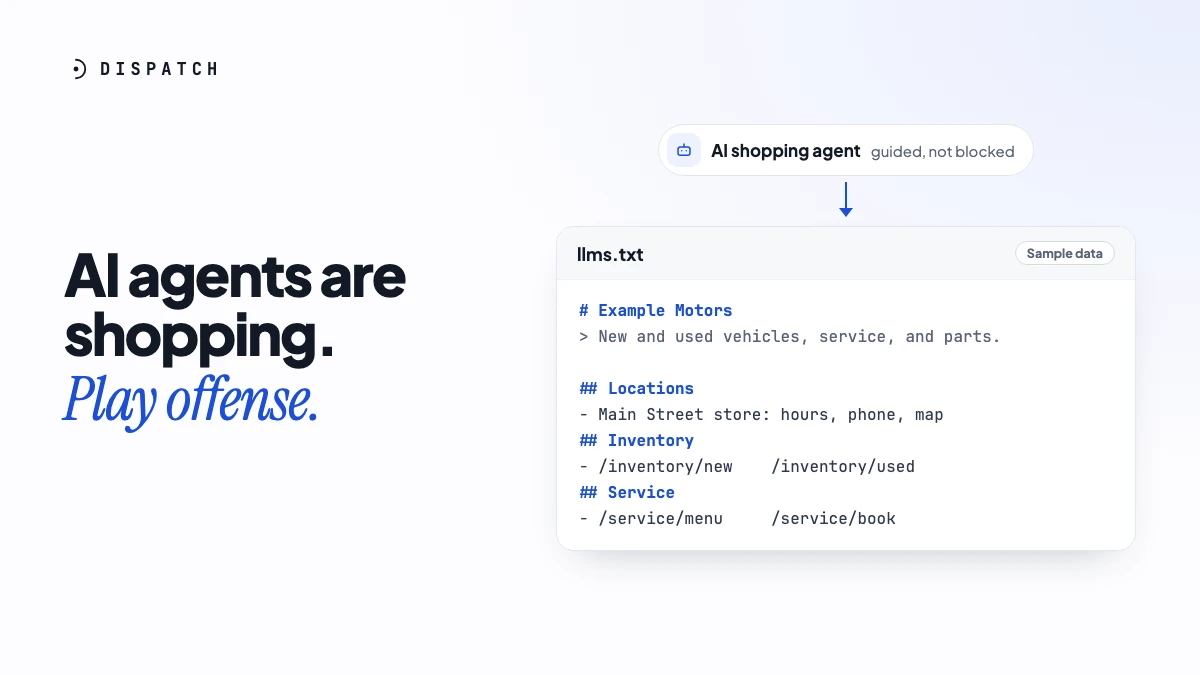
Instead of trying to block them, we're guiding them to particular places so they have all the clean and relevant data.
Why blocking backfires
An agent that cannot read your site still answers the customer. It answers from somewhere else: a listing site, a stale directory, a competitor's page, or its own guess. Blocking it does not take you out of the conversation. It takes out your version of the facts.
Give the agents a clean source
We are building what we call our company brain: one structured source of truth about the business, written in plain markdown, published where crawlers and agents look for it. Instead of making an agent piece the business together from a hundred pages, we hand it the clean version.
There is an emerging convention for this called llms.txt: a plain-text file at the root of a site that tells AI systems what the business is and where the important pages live. This site publishes one at /llms.txt.
A checklist for any business with a website
- Check your robots.txt and your firewall. Many sites block AI crawlers by default without anyone deciding to. Make it a decision.
- Publish an llms.txt. A short, accurate map of the business and its key pages.
- Add structured data. Schema markup for the business, locations, hours, and offers, so the facts are machine-readable instead of buried in design.
- Make every channel agree. The price on your site, in your listing feeds, and in your ads should match. An agent comparing sources will notice when they do not, and so will a regulator.
- Answer the real questions on the page. If customers ask whether you service a brand you do not sell, say so in plain text. Agents quote what they can find.
Consistency is the real work
None of this is a trick. An agent rewards the same things a careful customer does: accurate prices, clear policies, and information that agrees with itself everywhere it appears. The difference is that an agent checks every source at once. If your website says one thing and a third-party listing says another, the agent sees both.
That is also why we keep a person in control of anything that goes out to customers. The company brain feeds the agents and our own drafting tools, but what we publish is deterministic and reviewed. Agents read it. People decide what it says.
Where to start
Look up your own business in two or three AI assistants and ask what a customer would ask: the price of a specific model, your service hours, whether you do a particular repair. Write down every wrong answer. Each one is a page to fix, a feed to clean up, or a fact to publish where the agents can find it.
Start with one function
A 30-minute call. We map where your operation leaks time and scope what to automate first.
Book a Call