Every operator who brings AI into a business hits the same wall. The team hears "AI" and thinks about their job. The managers hear it and think about another invoice. Both reactions are reasonable, and both deserve a straight answer.
← Dispatch 
Getting buy-in: why our most automated departments are hiring
The fear is that AI replaces people. In our group, the departments with the most AI have the most job openings. How we earned the team's trust.
Ben Sporn Founder of Eagle Eye
Adapted from Ben's interviews on CBT Live, Auto Finance News and Auto Remarketing.
In this article 5 sections
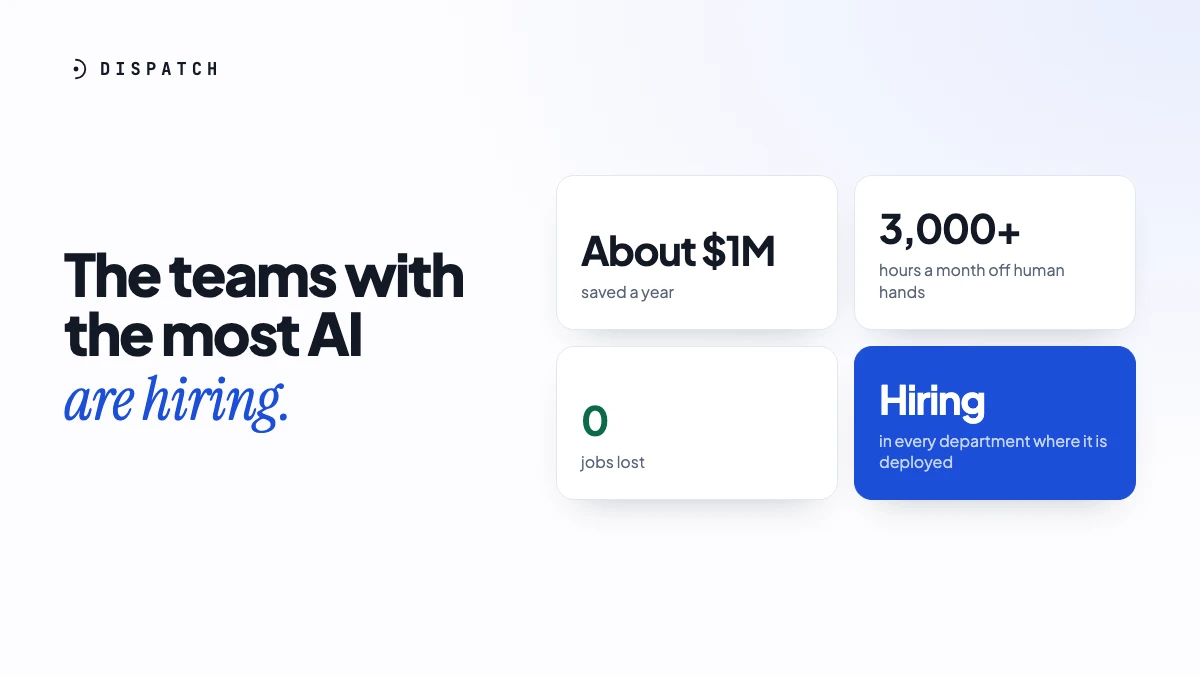
At VIP Automotive Group, where I am CMO, the answer turned out to be in the results. The departments where we have deployed the most AI are the ones with the most job openings. Across the group the work saves about $1M a year and takes more than 3,000 hours a month off human hands, and nobody lost a job.
The only pushback was cost
I expected resistance to the technology. What I got was a question about money: what is this going to cost? It came from managers and from the people on the floor alike.
The only pushback I got was around cost.
That is a fair question, because most AI is sold the way software always was: a seat for every person, every month. A modest seat price times everyone who needs one times twelve months is a real line item before anyone logs in. Our answer was to stop renting and start building, and to watch the token bill. It has gone down since we started, even as the work has grown. When the tools retire invoices along the way, the cost question answers itself.
Draft, do not decide
The design choice that earned the most trust was keeping a person in the loop. The first thing we built drafts replies to customer service tickets. It does not send them. A rep reads every draft and sends it. Output roughly tripled, and the reps stayed in charge of what the customer heard.
That pattern runs through everything we deploy. Anything customer-facing is reviewed by a person. The AI takes the lookup, the copying, and the first draft. People keep the judgment.
Build around the person
The fastest way to lose a team is to drop a tool on them that ignores how they actually work. We start from friction: what is grinding on a specific person's day, and across which systems. Sometimes we build a tool for exactly one job, and the person who does that job shapes every version. I wrote that up in Give every tool a champion.
The result is a team that asks for more. Our people love using these tools, and some of our best introductions to other dealer groups have come from our own employees.
Be honest about what changes
Nobody losing a job does not mean nothing changes. Parts of some roles need retooling, and some people stop doing certain tasks altogether. Say that out loud. What we have seen is that the time comes back as better work: more time with customers, more attention on problems that need judgment, and less manual grinding at the end of the day.
I think the person becomes more important, not less, because someone has to shape these workflows around the work they know best. There is a lot of untapped talent in retail: people with real intelligence who never had the tools to match it.
A short playbook
- Say plainly what the project is for, and what it is not for.
- Start with drafts a person approves, never with automation that talks to customers on its own.
- Pick a first project that removes the work people dislike most. Inbox and voicemail triage are usually the winners.
- Retire an invoice early, so the savings are visible to the people who asked about cost.
- Publish the before and after: hours back, response time, and whose afternoon came back.
Trust gets earned here the same way it does everywhere else in a dealership: do what you said you would, and show your work.
Start with one function
A 30-minute call. We map where your operation leaks time and scope what to automate first.
Book a Call