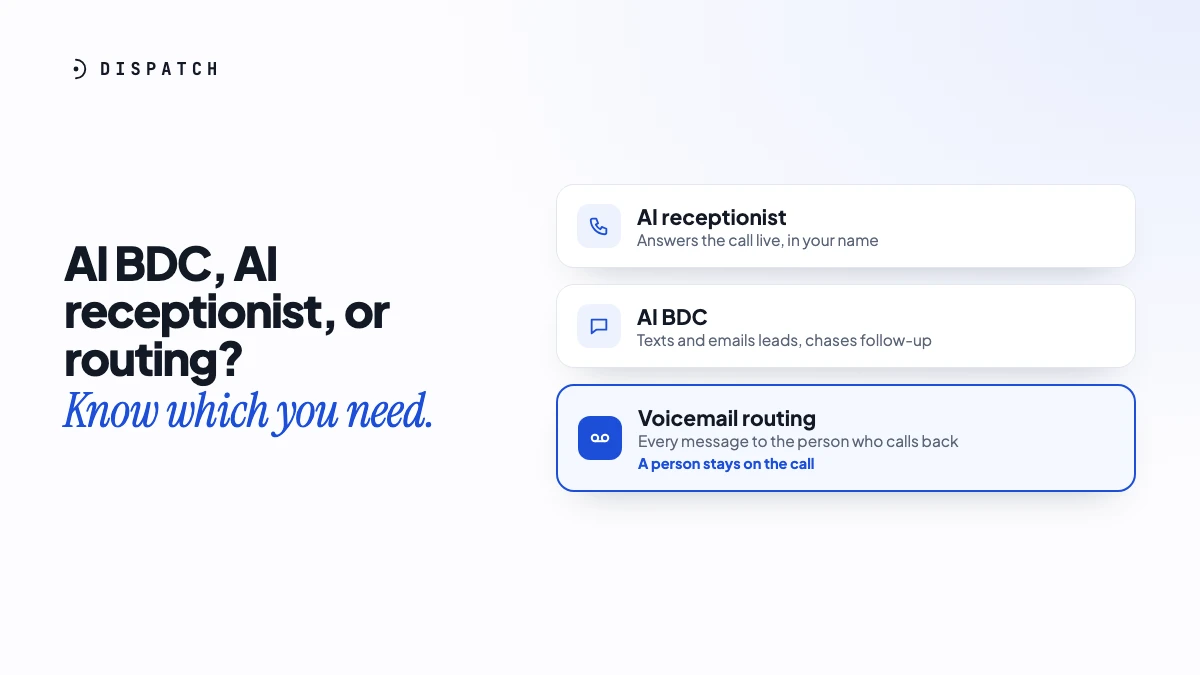
Search for dealership AI and you will find three things sold under overlapping names: the AI BDC, the AI receptionist, and voicemail routing. They solve different problems. Buying the wrong one is how a store ends up with a bot talking to customers when what it needed was its own people calling back faster.
← Dispatch 
AI BDC vs AI receptionist vs voicemail routing: what a dealership needs
Three things sold under overlapping names. What each does, where each goes wrong, and how a dealer group should choose.
Ben Sporn Founder of Eagle Eye
In this article 7 sections
Here is what each one does, where each goes wrong, and how to choose.
The AI receptionist
An AI receptionist answers the phone. A voice model picks up, greets the caller, answers simple questions, books appointments, and transfers calls it cannot handle.
Where it fits: high call volume with simple, repeatable questions, such as hours, directions, and booking a service slot, and a team that genuinely cannot pick up.
Where it goes wrong: the caller is talking to a machine at the moment they reached out to you. When it misunderstands a recall question or a payoff request, the mistake is live, in your name, with no one in between. Ask how it hands off, and how often.
The AI BDC
An AI BDC works the lead pipeline: it texts and emails new internet leads, follows up on shoppers who went quiet, and tries to set appointments, usually in a conversational back and forth.
Where it fits: a large volume of internet leads that are not getting a timely first touch, and a clear handoff to a salesperson once a shopper engages.
Where it goes wrong: volume is easy and quality is hard. Customers can tell when every message is the same, and a bot that keeps pushing for an appointment after a shopper said no damages the store's name. Ask what it is allowed to send without a person, and who sees the conversations.
Voicemail routing
Voicemail routing does not answer anyone. Every call that rolls to voicemail is transcribed, summarized in a line, flagged for urgency, and sent to the person who should call back, by name, in their inbox or channel.
Where it fits: calls are being missed because people are busy, not because nobody is there, and the real problem is that messages sit in a shared box with no owner.
Where it goes wrong: it only helps if someone calls back. It is an accountability tool, so it needs managers who look at what was returned and what was not.
Side by side
| AI receptionist | AI BDC | Voicemail routing | |
|---|---|---|---|
| Talks to the customer | Yes, live on the phone | Yes, by text and email | No, your people do |
| Main job | Answer and book | Work leads and follow up | Get every message to its owner |
| Biggest risk | A live mistake in your name | Volume over quality | Messages routed but not returned |
| Best first fit | Simple, high-volume calls | Leads with no first touch | Missed calls in a busy lane |
| What a person approves | Usually nothing in the moment | Depends on the vendor | Every callback |
What we build, and why
Eagle Eye builds the third kind, and the reporting around it. At VIP Automotive Group, where Eagle Eye's founder is CMO, voicemail is transcribed and routed on more than 100 phone extensions, with call intelligence across 10 locations and every voicemail emailed as text. On the parts hotline alone, more than 350 voicemails were transcribed and matched to their orders in two weeks. The reporting work includes BDC call scoring and lead accountability, described in Ben's article The Cost of Not Implementing AI in a High Fixed Cost Business.
The reason is the same rule we use everywhere: agents draft, people decide. A customer who calls a dealership service department wants a person who knows the answer. The fastest way to give them one is to make sure the right person knows the call happened, with the context already written down.
Missed call, 10:15 amSample data
- Transcript: "Hi, calling about my Equinox, the shop said the part came in..."
- Summary: parts arrived, wants to book the install
- Routed to: service advisor on the open RO
- Urgency: normal, callback today
Questions to ask any vendor
- What can it send or say to a customer without a person approving it?
- Where do the transcripts and conversations live, and who owns them if you leave?
- Does it work inside your phone system, DMS, and CRM, or beside them?
- How do managers see what was missed, not just what was handled?
- How do you switch it off for one store without breaking the others?
How to choose
If calls go unanswered because nobody is there, look at a receptionist, carefully. If leads go cold because nobody touches them, look at a BDC tool with a person approving what it sends. If calls are missed because the team is busy and messages have no owner, start with routing. Before buying either of the first two, check whether the real problem is the third.
Start with one function
A 30-minute call. We map where your operation leaks time and scope what to automate first.
Book a Call